
My Loss & Found Box
At age four I was a fearless princess in my puffy orange lifejacket, staunchly astride the bow of my Pappaw’s motorboat (the “Peapicker,” also his nickname for me). Christened during the Cold War along the brackish lapping of the Susquehanna River, I quickly learned to jump in the ocean’s surf, daring the waves to knock me down. Next to me was a pillar—my father, my Hercules, my first lighthouse before I ever knew rocky shores. He gave me a souvenir from that idyllic summer vacation. I slid onto my finger a small ring with a luminous, magical stone: a Cape May diamond. Two months later, both my father and my ring were gone.
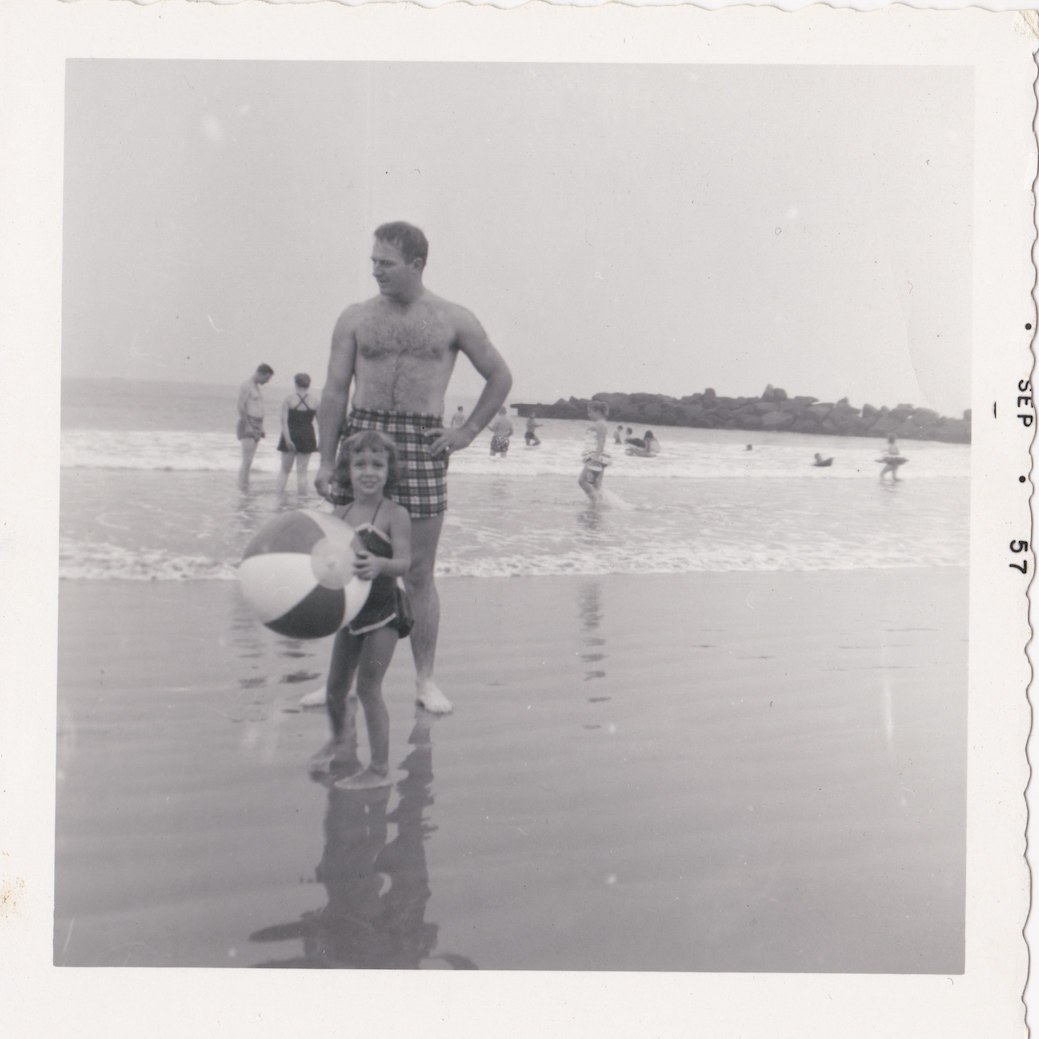
My father was electrocuted while working on a utility pole a few miles from the dream home he was building for my mother, my younger sister, and me. I didn’t know immediately how Daddy got lost. No one, in their collective trauma, had the words to explain things even to themselves. And I don’t know where or how I lost my cherished ring. In all these nearly 70 years that have passed, I still am on alert for signs of them both.
Dianne died of colon cancer three years ago. Her daughter (my only niece) planned to pass through the Hudson Valley where I live and unload some things. Her millennial generation doesn’t want this kind of family stuff. It packs a double-whammy of emotional and physical clutter, and is a hugely popular online topic: “Your Kids Don’t Want Your Brown Furniture!” Losing her mom (my sis) sent Delaney into overdrive, pitching things into the hired dumpster with heart-stopping abandon. I know it helped her, but I stressed over what sentimental treasures ended up as landfill.
A carton of cherrypicked items escaped that fate. I realized when I opened it that my sister had been squirreling away some pretty great things unbeknownst to me. We both loved quirky gee-gaws, old photos, and things with a mystery or a history. Preferably family history. Dianne was terrific at pulling a great-great uncle’s name out of the blue or off the smallest branch of the family tree, while my forte was arranging mementos into assemblage art. We didn’t see each other often, but one of my favorite times in the last ten years of her life was meeting up in our hometown. We visited my very first house, that as a newborn I shared with our parents and grandparents. Then we hit the cemeteries, spotting our tribe’s simple stone markers flat in the ground, the dandelions and grass encroaching chiseled detail from the early 1900s. I thought that I (firstborn, first dibs!) had already seen and/or acquired every worthwhile Watts family artifact.
In the box were embossed leather photo albums bound with silken tasseled cord protecting velvety soft black paper pages of neatly aligned black and white photos. Beautiful white-inked cursive identified the people and the setting. The adhesive photo corners, once licked by my great-grandmother, were still mostly attached, if only by a whisper of DNA.
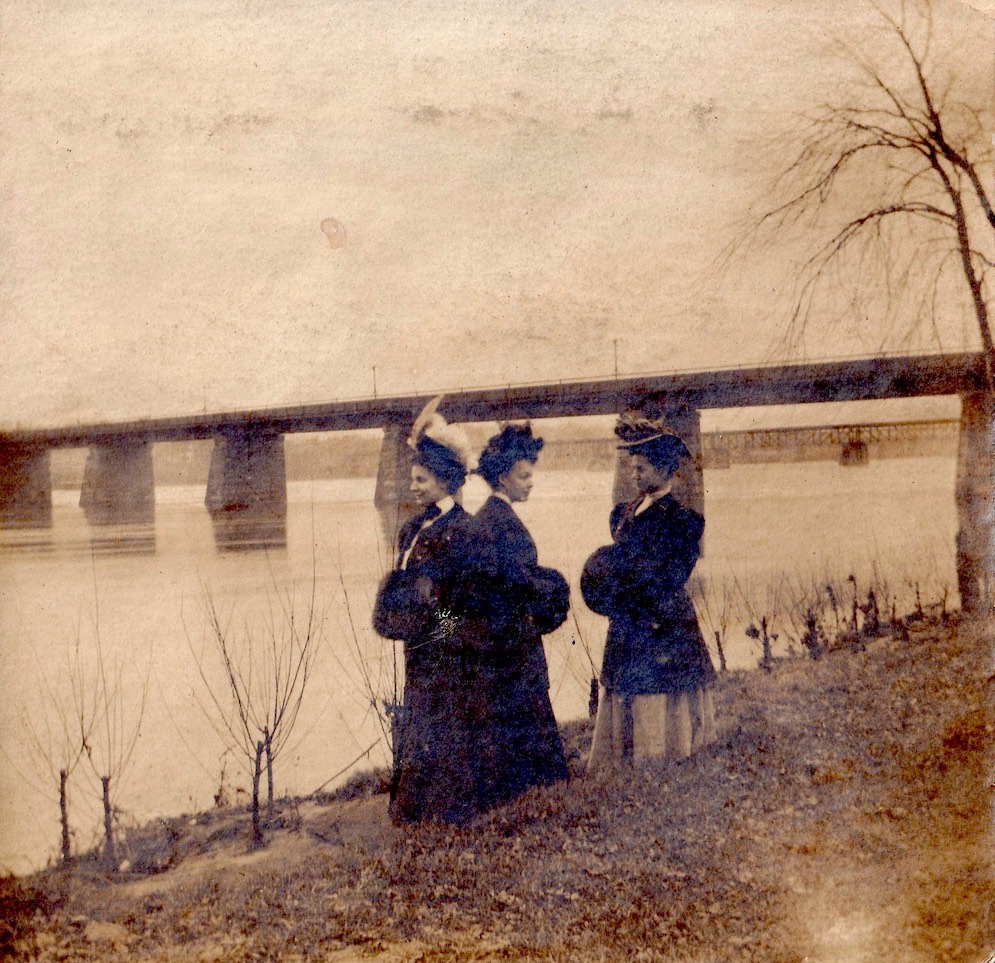
Edwardian and flapper-era women—a multi-generational melange of my family—posed in front of porches and in alleyways behind narrow yard plots bordered with roses and peonies, or they would take someone’s state-of-the-art roadster for a jaunt into the nearby countryside. In one of my favorite photos a shadowy trio is etched along the banks of the Susquehanna River in long black coats, feathered hats, with hands in huge fur muffs—each seemingly lost in her own thoughts. These three are my great-great aunts, evoking an Edith Wharton elegance to their modest lifestyles. I had pored over my family tree enough on MyHeritage.com to know that the Pennsylvania Railroad shortened or took men’s lives in my family, and generational stoicism about loss and grief and its trickledown effect has filtered into my own life. Fathers became son-less. Wives became widows. Unmarried women, “spinsters,” took on jobs, even carved out careers. Born of necessity, it would seem, but I’d like to think that at least one of them, my Great-Great Aunt Irma, chose to take the driving wheel of her life and hit the gas.
Slipped into the box of mementos now in my possession was a slim wisp of a silver ring suspending a single oval of black onyx the size of a dew drop. I imagined this to have once been on the hand of Irma Augusta Watts. My sister had our relative’s yellowing obituary tucked in the box along with some newspaper articles written in context of her career with the Pennsylvania Legislative Reference Bureau. I saw that she visited New York City on a work-related trip with “a lady companion” . . . hmmm . . . and suddenly Aunt Irma started to coalesce from the ephemera. I tried to wear the heirloom on my ring finger but the tiny stone floated to my palm side before I coaxed it around again and again. Worried that I would lose it, I hung the silver hoop on a brass filigree frame with a photo of her great-nephew, my father, at age two.
Finally I resolved that this reminder of Aunt Irma would live on my left ring finger until my own time on Earth was over. I went to the local jeweler to have it resized and picked it up on what would have been my father’s 95th birthday. As I slipped the ring onto my left hand I felt it was still just a tad loose, but overriding that was a cosmic tingle: the black matte stone’s yin to the iridescence of my childhood Cape May diamond’s yang. Irma and Daddy were orchestrating this. I smiled in my magical thinking.
On the last day of 2025 I was more than ready to slam the door to the year. I was at an afternoon gathering to celebrate—not that holiday of forced gaiety, but a friend’s milestone birthday. My often socially awkward self had found refuge in a kitchen conversation I had easily plugged into, and my gesticulating left hand sent my ring flying. The slender silver band with a black onyx eye was spotted winking near a plate of home-baked cookies. I scooped it up—relieved and dismayed.
Later that New Year’s Eve, at another gathering and with more animated hand gestures (fueled by a bit of wine), I glanced down to find my ring gone. Again. I bolted from the conversation to search my glove and coat pockets, which only yielded the sick feeling that my ring had slid off in the icy driveway as I loaded the front seat with my pot luck offering. Worse: now snow was in the air. I’ll cut to the chase here. Hostess #1 had found my ring and circulated the pic in a group text on New Year’s Day. I retrieved it within an hour, as I breathed in the cold clear air with all of its fresh promise. I had learned at least one practical lesson.
Then I stepped back to view the past year of loss. Financial security, trust in our leaders, beloved cultural icons, friends and classmates . . . youth! I was no longer that four-year-old safe in the folds of her family and ready to take on the world. Almost lost not once but twice, the ring is even more meaningful to me than when I first slipped it on. But this past year brought into glaring focus what is even more precious, and now in dire need of holding onto.
When my Great-Great Aunt Irma wore this ring and stood on the steps of the Pennsylvania state capitol in a professional capacity, we as a country were on the brink of capitulating to American fascism. When my father gave me my sweet Cape May diamond ring, the Cold War was ramping up and the fear of nuclear annihilation loomed, giving a brand new template for the idea of loss.
And so I begin the year 2026 with a resolve to be mindful of each and everything I do, to appreciate what I have and what we are in danger of losing. And to never lose hope that all is not lost.
Ever.
copyright sharon watts 2026
 Sharon Watts Writes
what a wonderful story and sentiments. So well written.
Thank you so much!
Beautiful how it covers generations and loss. Thank you
Thank you for reading, and I appreciate your comment!
Thank you for sharing this. So beautifully written. I’m so proud of you!
Thanks! 🙂